
Fanvil H2U - V2 White Hotel Phone
AIM Telecom provides troubleshooting and configuration support for this product to businesses across Toronto and the GTA. Contact us to confirm whether the issue can be handled by phone or requires on-site service.
Get Support Call 416-312-4819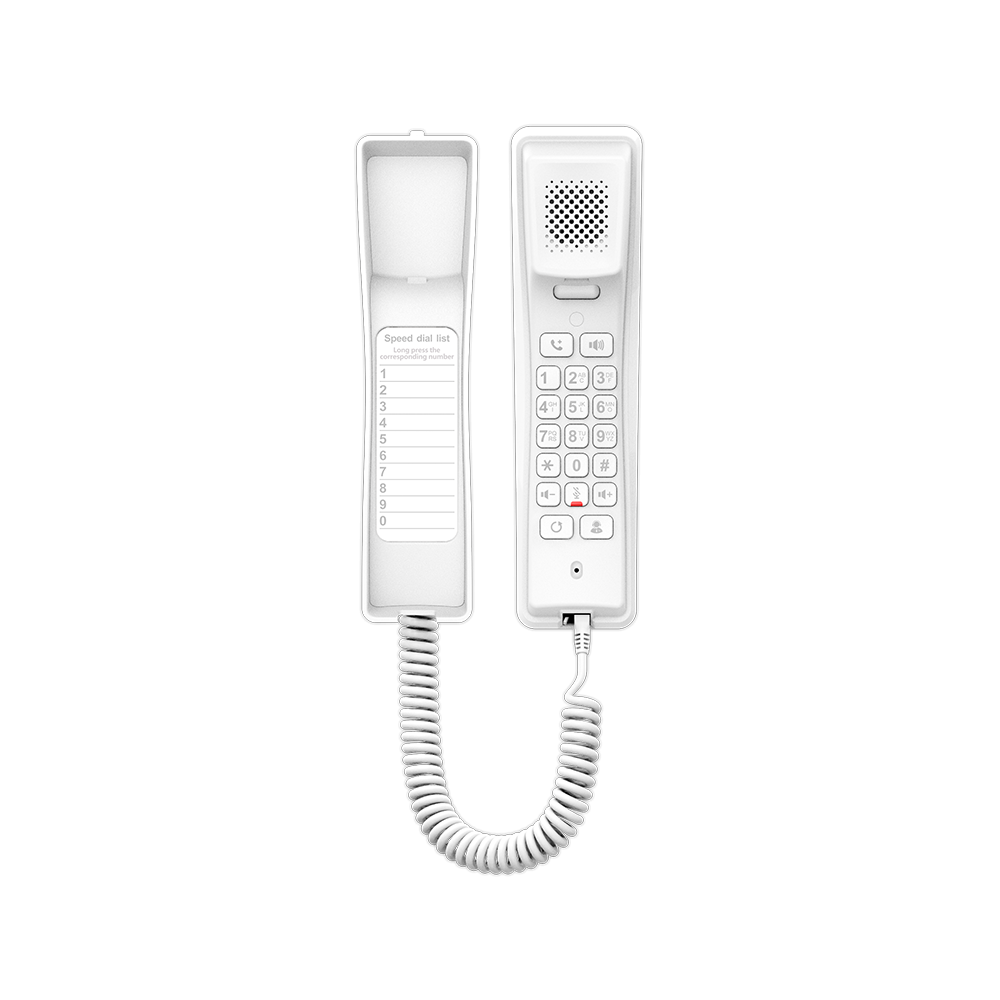
Common issues and fixes
Reviewed troubleshooting steps are not yet available for this model.
Ask AIM Telecom about this productAbout this product
The Fanvil H2U - V2 Hotel phone is a compact and lightweight solution, suitable for both wall mounting or desktop use. It offers HD Voice and Opus technology for stable and clear audio even in loud environments.
This hotel phone can serve as a hotspot, sharing one number from the server, allowing multiple phones to ring together when a call comes in. This feature enables seamless communication from any location within your business.
The H2U - V2 is available in Black and features:
• 2 SIP Lines
• HD Audio with wideband Codec (G.722, Opus)
• 10 speed dial keys, 1 programmable DSS Key
• 3-way Conference
• Desk/wall-mounted mode
• Handset / Hands-free mode
• 10/100 Mbps
• PoE/Power adaptor
For a full list of specifications and detailed product information, please refer to the Fanvil H2U-V2 datasheet.
This hotel phone can serve as a hotspot, sharing one number from the server, allowing multiple phones to ring together when a call comes in. This feature enables seamless communication from any location within your business.
The H2U - V2 is available in Black and features:
• 2 SIP Lines
• HD Audio with wideband Codec (G.722, Opus)
• 10 speed dial keys, 1 programmable DSS Key
• 3-way Conference
• Desk/wall-mounted mode
• Handset / Hands-free mode
• 10/100 Mbps
• PoE/Power adaptor
For a full list of specifications and detailed product information, please refer to the Fanvil H2U-V2 datasheet.
More product details
The Fanvil H2U-V2 is a purpose-built hotel phone that fits neatly into guest rooms, dormitories, and assisted-living suites, but its feature set also makes it a practical choice for small Canadian retail counters, branch teller stations, or quiet office common areas where a full-featured desk phone would be wasted. It gives you the essential call controls—two SIP lines, a handful of speed dials, and a programmable DSS key—without adding the cost or complexity of a large colour screen. Because it supports both PoE and a standard power adapter, it slots easily into existing structured-cabling builds or older properties where power is pulled locally.
What sets this model apart from a generic entry-level phone is its hotspot capability: multiple H2U-V2 units can share a single extension from the server, so a call rings every phone in the group. For a motel office, a small retail chain, or a dental practice with several operator stations, this simplifies call handling and keeps the dial plan clean. The wideband audio codecs (G.722 and Opus) do a surprisingly good job of cutting through background noise, which matters in lobbies and open-plan spaces.
Buyers should understand the limits of the 10/100 Mbps Ethernet port. It is fine for voice traffic, but if you plan to daisy-chain a PC through the phone, that computer will be capped at fast-Ethernet speeds—acceptable for a point-of-sale terminal or a lightweight kiosk, but a bottleneck if a guest or staff member expects gigabit throughput. The single programmable DSS key and ten speed dials are enough for the most-called contacts or a parking orbit, but this is not a phone for a heavy reception role that demands a sidecar or a busy BLF panel.
For a Toronto-area hotel or property-management group deploying dozens or hundreds of endpoints, the H2U-V2 hits a sensible balance of cost and voice quality. It is overkill for a storeroom that only needs a paging endpoint, and it is underpowered for a front-desk supervisor who handles multiple lines and needs visual presence indicators. In the Canadian context, it pairs naturally with hosted PBX platforms that support zero-touch provisioning over HTTP/HTTPS, and the Opus codec helps maintain intelligibility even when the WAN link is modest—a real consideration for properties in rural Ontario or the North.
What sets this model apart from a generic entry-level phone is its hotspot capability: multiple H2U-V2 units can share a single extension from the server, so a call rings every phone in the group. For a motel office, a small retail chain, or a dental practice with several operator stations, this simplifies call handling and keeps the dial plan clean. The wideband audio codecs (G.722 and Opus) do a surprisingly good job of cutting through background noise, which matters in lobbies and open-plan spaces.
Buyers should understand the limits of the 10/100 Mbps Ethernet port. It is fine for voice traffic, but if you plan to daisy-chain a PC through the phone, that computer will be capped at fast-Ethernet speeds—acceptable for a point-of-sale terminal or a lightweight kiosk, but a bottleneck if a guest or staff member expects gigabit throughput. The single programmable DSS key and ten speed dials are enough for the most-called contacts or a parking orbit, but this is not a phone for a heavy reception role that demands a sidecar or a busy BLF panel.
For a Toronto-area hotel or property-management group deploying dozens or hundreds of endpoints, the H2U-V2 hits a sensible balance of cost and voice quality. It is overkill for a storeroom that only needs a paging endpoint, and it is underpowered for a front-desk supervisor who handles multiple lines and needs visual presence indicators. In the Canadian context, it pairs naturally with hosted PBX platforms that support zero-touch provisioning over HTTP/HTTPS, and the Opus codec helps maintain intelligibility even when the WAN link is modest—a real consideration for properties in rural Ontario or the North.