Grandstream DP735 Ruggedized High-Tier DECT Handset

Frequently Asked Questions

First, confirm the charger cradle is receiving power by checking that its LED indicator is lit. If not, reseat the power supply connection and try a known-working outlet. Remove the battery from the handset, wipe the metal contacts on both the battery and inside the handset with a dry cloth, then reseat the battery firmly and place the handset back in the cradle for at least 30 minutes.
Verify that the base station is powered on and that its DECT radio is enabled. Move the handset closer to the base—ideally in the same room—and try again, as range or interference can block the initial pairing. If the base uses a PIN for registration, double-check that you are entering the correct PIN on the handset when prompted.
Audio dropouts on a DECT handset are often caused by Wi-Fi access points or other 2.4 GHz devices placed too close to the base station. Try relocating the base at least a metre away from any router or access point. Also check that the handset’s firmware is up to date via the base’s web interface, as older firmware versions sometimes had jitter buffer issues.
Push-to-talk is a feature that must be configured on the base station or IP PBX side; it is not active by default. Log into the base station’s web interface and look for the PTT settings to define a multicast paging group or an intercom target. Once that is set, the handset’s dedicated button should trigger the function.
The DP735 uses standard DECT protocols, so it may register with a third-party DECT base that supports generic GAP-compatible handsets. However, advanced features like push-to-talk, automated provisioning, and seamless integration with Grandstream’s UCM zero-config depend on a Grandstream base. For full functionality, stick with a DP750, DP752, or DP755.
The DP735 is IP67-rated, so brief immersion should not cause permanent damage. Muffled audio is often just water in the speaker grille. Power the handset off, remove the battery, and let it air-dry in a warm, well-ventilated spot for several hours. Do not use a hair dryer or compressed air, as that can push moisture deeper into the seals.
Make sure the handset is sitting in its charging cradle and remains within strong signal range of the base throughout the update. Interruptions from moving out of range or a low battery will cause the update to abort. Also confirm that the base station itself has a stable internet connection and that its own firmware is current before pushing a handset update.
A Grandstream DECT base station like the DP750 supports multiple handsets—typically up to five or ten depending on the model—with each handset able to access up to 20 SIP accounts. Adding handsets does not degrade individual call quality, but the total number of simultaneous calls is limited by the base’s channel count, so plan your deployment around peak call volume.
IP Phones

Grandstream DP735 Ruggedized High-Tier DECT Handset
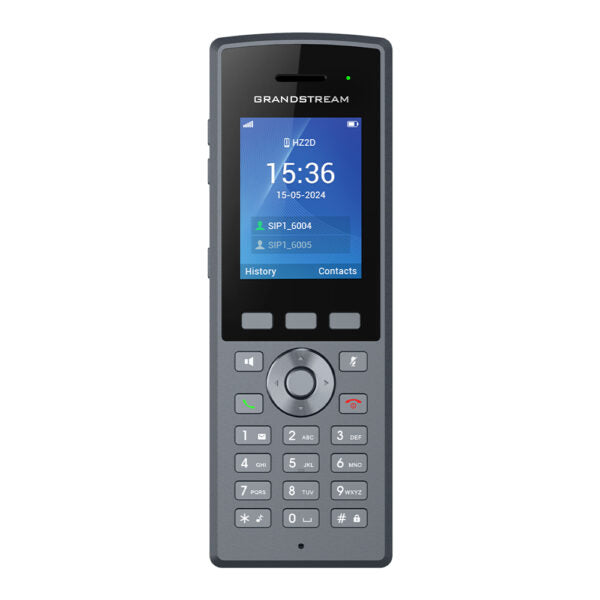
The DP735 is a ruggedized DECT cordless IP phone designed for businesses and residential environments. Key features include: • Up to 20 SIP accounts per system • DECT authentication & encryption technology for secure calls • 3-way audio conferencing for easy conference calls • Dedicated Push-to-Talk button with built-in proximity and accelerometer sensors • Automated provisioning options, including TR-069 and XML config files • Compatible with Grandstream’s UCM series of IP PBXs for Zero Config provisioning • HD audio to maximize audio quality and clarity • Ruggedized design with IP67 Rated-Waterproof, dust-proof, cleaning chemical resistant, anti-microbial casing, and drop safe from 2.5m Package Contents: Handset Unit Universal Power Supply Charger Cradle Belt Clip 1 Battery Quick Start Guide Air Interface: Telephony standards: DECT Frequency bands: 1880 – 1900 MHz (Europe), 1920 – 1930 MHz (US) Number of Channels: up to 10 (Europe), up to 5 (US, Brazil or Japan) Outdoor Range: up to 400 meters (DP752/DP755) or up to 300 meters (DP750) Indoor Range: up to 50 meters Protocol/Standards: HAC compliant Voice Codecs: G.722 codec for HD audio and G.726 codec for narrow band audio (G.711μ/a-law, G.723.1, G.729A/B, iLBC and OPUS) Telephony Features: Hold, transfer, forward, 3-way conference, push-to-talk, intercom, downloadable phonebook, call waiting, call log, auto answer, click-to-dial, flexible dial plan HD Audio: Yes, both on Handset and Speakerphone Security: DECT authentication & encryption Upgrade/Provisioning: Software Upgrade Over-The-Air (SUOTA), handset provisioning Over-The-Air Multi-line Access: Each handset may access up to twenty (20) lines Dimensions (H x W x D): Handset: 166.00 x 57.80 x 26.30mm Charger cradle: 82.00 x 80.00 x 30.60mm

About This Product

The DP735 is built for workplaces where a standard desk phone would not survive the day. Warehouses, manufacturing floors, outdoor service yards, and even busy restaurant kitchens are natural fits. The ruggedized casing shrugs off drops, dust, and chemical cleaning, while the IP67 rating means a splash or a brief dunk will not end a shift. It pairs with Grandstream’s DECT base stations (DP750, DP752, DP755) and integrates cleanly into a UCM-based IP PBX, making it a practical extension for a company that already runs Grandstream voice infrastructure.

Because it is a DECT handset, not a Wi-Fi device, it relies on a base station for connectivity. This gives it excellent voice quality and handoff within the base’s coverage area, but it also means you cannot simply connect it to a corporate Wi-Fi network and go. The quoted indoor range of up to 50 metres is typical for DECT, though steel shelving and thick concrete will reduce that considerably. In a large facility, careful placement of multiple base stations is essential to avoid dead zones.

For a Toronto-area business, the handset’s resistance to road salt, slush, and wide temperature swings is a genuine advantage if the phone moves between a heated office and a loading bay. The sealed design also holds up well against the fine dust common in older industrial buildings around the GTA. It is not, however, a replacement for an intrinsically safe device in hazardous locations; the IP rating covers water and dust, not explosive atmospheres.

This handset is overkill for a carpeted office where a standard cordless phone would do. It is also not the right choice for a user who needs a large colour screen, video calling, or a smartphone-like app experience. Where it excels is in giving a worker a reliable, loud, and near-indestructible voice endpoint that simply works after a hard knock.
Services We Provide
  • Professional Installation & Configuration
  • Ongoing Maintenance & Support
  • Troubleshooting & Repairs
  • System Upgrades & Updates