Grandstream DP752 Long-range DECT VoIP Base Station

Frequently Asked Questions

Start by checking the base station’s LED indicators and its network connection. Confirm the Ethernet cable is seated at both ends and that your switch port is providing PoE or that the external power supply is connected. If the link light is solid but handsets still show no line, log into the base’s web interface and verify at least one SIP account shows a green Registered status. A registration failure usually points to incorrect SIP credentials or a network firewall blocking the required ports.
Each DP752 supports up to five handsets, so the first thing to verify is that you haven’t reached the registration limit. On an already-working handset, navigate to the base settings menu and check the list of subscribed handsets. If fewer than five appear, put the new handset into registration mode while standing within a few meters of the base to rule out range issues. Interference from nearby electronics can occasionally prevent pairing, so temporarily moving the base away from large metal objects or active Wi-Fi access points can help.
Dropped calls during movement usually indicate the handset is reaching the edge of usable indoor range, which is often shorter than the rated maximum if the signal must pass through concrete, steel studs, or elevator shafts. Walk the path while watching the handset’s signal indicator to find dead spots. A practical first step is repositioning the base higher and away from metal shelving; even a few feet can make a difference. If coverage gaps persist across a large or obstacle-heavy floor, a second base station or a DECT repeater may be needed.
Check which codec the base is negotiating with your SIP provider. G.722 delivers the HD audio the DP752 supports, while G.711 provides standard quality; a forced narrowband codec like G.729 can sound compressed. In the web interface under account settings, verify the preferred codec list and that HD audio is enabled. Also confirm your network has consistent low jitter and latency, because packet loss on a congested link will degrade audio regardless of codec selection.
First, check whether the PoE switch port still delivers power by plugging in another PoE device or looking at the switch’s port status LED. If you use an external DC adapter, test it with a multimeter or swap it with a known-good supply of the same voltage and polarity. Give the base a full minute after restoring power; it can take time to boot and re-register its SIP accounts. If the LEDs remain dark with verified power, the issue is likely hardware-related and warrants a support call before attempting any reset.
Yes. Assign that SIP account to multiple handsets in the base’s web configuration and set the ring mode to shared or parallel on each handset’s account settings. All five will ring together when the number is called, and any one of them can answer. Just keep the five-concurrent-call limit in mind: if multiple calls are active, additional incoming calls to that shared line may get a busy signal unless you have call waiting enabled.
The DP752 uses standard SIP, so it works with most Canadian VoIP services that support SIP registrations, including providers serving Toronto and the GTA. A quick pre-purchase check is to ask your provider if they support third-party SIP DECT bases and whether they have any specific codec or transport requirements. Most will simply provide the SIP server address, username, and password you enter in the base’s account configuration page.
DECT range indoors can be cut short by dense materials like brick, concrete block, or foil-backed insulation. Try moving the base station to a more central location, elevated and away from large metal filing cabinets or server racks. A quick test is to bring the handset into the same room as the base and see if the warning clears immediately. If the issue remains even at close range, re-register the handset to rule out a corrupt pairing.
The DP752 supports automated provisioning through XML configuration files and TR-069. You can host a config file on a local HTTP or TFTP server and point the base to it via Option 66 in your DHCP scope, or use your platform’s zero-touch provisioning URL if you have one. For larger rollouts across Canadian offices, this saves considerable setup time and ensures every base follows the same dial plan and firmware version.
Start by checking whether your network has any scheduled maintenance, DHCP lease renewals, or firewall session timeouts that could interrupt traffic during idle periods. In the base’s SIP account settings, confirm the registration expiration interval isn’t set so long that the provider drops the session before it renews; a value around 60 to 120 seconds is typical. If your firewall or router uses SIP ALG, try temporarily disabling it to see if it interferes with keep-alive traffic.
IP Phones

Grandstream DP752 Long-range DECT VoIP Base Station
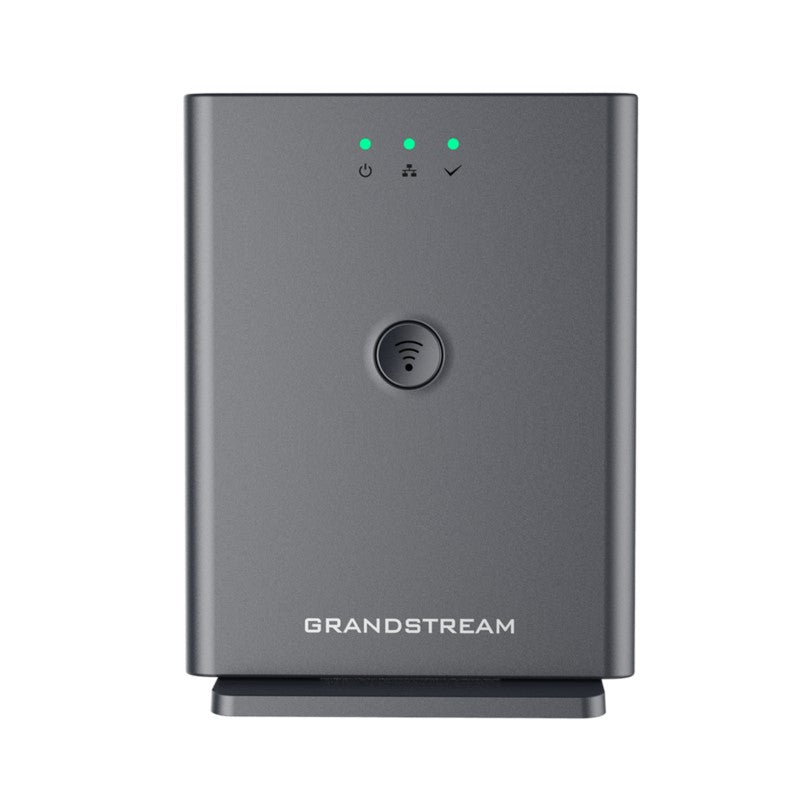
The DP752 is a powerful DECT VoIP base station that pairs with up to 5 of Grandstream's DP series DECT handsets, offering mobility to business and residential users. Key features include: • Supports up to 10 SIP accounts and 5 concurrent calls • 3-way voice conferencing and full HD audio • Integrated PoE for reliable connectivity • Seamless unified calling with shared SIP account across all handsets • Supports Push-to-Talk and activity-based on proximity and accelerometer sensors • Automated provisioning options, including TR-069 and XML config files The base station also features: • Outdoor range of up to 400 meters with the DP730 or up to 350 meters with DP722/DP720 • Indoor range of up to 50 meters • Weight: 1 lbs • Dimensions: 9 × 7 × 3 in • Phone Type: DECT Technical specifications: • Telephony standards: DECT • Frequency bands: + 1880 – 1900 MHz (Europe) + 1920 – 1930 MHz (US) + 1910 – 1920 MHz (Brazil) + 1786 – 1792 MHz (Korea) + 1893 – 1906 MHz (Japan) + 1880 – 1895 MHz (Taiwan) • Number of Channels: 10 (Europe), 5 (US, Brazil or Japan), 3 (Korea), 8 (Taiwan) • Outdoor Range: up to 400 meters (DP730) or up to 350 meters (DP722/DP720) • Indoor Range: up to 50 meters For a full list of specifications, please refer to the product datasheet.

About This Product

The DP752 is a DECT base station built for businesses that want reliable cordless mobility without giving up the call handling of a desktop VoIP phone. It is a natural fit for warehouses, retail floors, medical offices, and any multi-room environment where staff move around but still need access to multiple lines. Because it supports up to five handsets and ten SIP accounts on a single base, a small team can share a central number while each handset keeps its own extension, or a single user can roam with one handset that rings for several lines. The integrated PoE simplifies cabling, letting the base live near the ceiling or in a wiring closet where power outlets are scarce.

The real strength of the DP752 is coverage. Paired with a DP730 handset in open air, range can stretch to roughly 400 meters, which covers most small-to-medium yards, parking lots, and shop floors. Indoor range will vary with construction materials, but in typical drywall-and-glass offices it comfortably serves a full floor. For Canadian businesses in dense GTA office parks or multi-tenant buildings, the DECT band used in North America avoids interference with Wi-Fi and Bluetooth traffic that often clogs 2.4 GHz spectrum, so voice quality tends to hold up well even in RF-noisy environments.

Buyers should keep a few practical limits in mind. The base caps concurrent calls at five, regardless of how many handsets are registered. A busy front desk sharing a line across five handsets will burn through that quickly; if the team regularly fields more simultaneous calls, a single DP752 may feel tight. Range figures assume clear line of sight; steel framing, concrete walls, and large metal racking will cut indoor reach well below the rated maximum, so a site walk with a handset is worth doing before committing to a single base for a large footprint.

For a Toronto professional-services office with a handful of roaming staff, this base paired with a few DP722 or DP730 handsets offers a clean cordless experience at a modest price. It is overkill for a home office where a single cordless handset on an ATA would suffice, and underpowered for a distribution center with dozens of pickers who all need a handset on the floor: those deployments usually call for a multi-cell DECT system rather than a lone base station.
Services We Provide
  • Professional Installation & Configuration
  • Ongoing Maintenance & Support
  • Troubleshooting & Repairs
  • System Upgrades & Updates