Grandstream DP755 Carrier Grade HD DECT Base Station with Extended Range

Frequently Asked Questions

First, check that the Ethernet cable is securely connected to a PoE-enabled switch port or that the included power supply is plugged into a working outlet. Verify the Power LED on the base station is illuminated; if not, test the Ethernet cable with another PoE device to confirm the switch port is delivering power. Also, ensure your PoE switch can provide sufficient power per port—if it is overloaded, the base station may not receive enough power to boot.
Ensure the handset is within range of the base station—try moving closer to see if the registration holds. On the handset, verify the SIP account settings (SIP server, user ID, and password) are entered correctly and that the base station’s IP address is reachable on your local network. A quick check is to reboot both the base and handset; if the problem persists, confirm the base station’s SIP account status in its web interface to see if the registration is being rejected by your VoIP provider.
First, identify if the issue is with the local DECT link or the network. Move the handset closer to the DP755 base station to rule out range-related interference. If audio improves, the base may need to be relocated away from large metal objects or dense walls. If the problem occurs on all calls regardless of distance, check your network for jitter or packet loss by examining the switch port statistics or running a brief network quality test.
The DP755 supports zero-config provisioning with Grandstream’s UCM series of IP PBXs. For other platforms, you can use TR-069 or host an XML configuration file on a local server. The base station’s web interface allows you to point it to a configuration server path, and upon boot, it will pull its settings automatically, which is efficient for deploying several units at once.
The DP755 is designed to work with Grandstream’s DECT handsets, such as the DP730, DP722, and DP720. While it uses the DECT standard, interoperability with handsets from other manufacturers is not guaranteed and may result in limited or no functionality. For a reliable system, it is recommended to pair it with a compatible Grandstream handset.
A solid green Network LED indicates a good Ethernet link. If it is off, check the Ethernet cable connection at both the base station and the switch, and try a different cable or switch port. If it is blinking green but you still cannot make calls, verify the base station has a valid IP address from your DHCP server by checking its web interface or your router’s client list. A missing IP address often points to a VLAN configuration issue on the switch port.
Push-to-Talk (PTT) is managed through the handset’s settings, not the base station directly. On a paired Grandstream handset, navigate to its menu to enable and assign a softkey for PTT. The DP755 base station simply passes this feature through; ensure your handsets are registered and on the same broadcast domain for local PTT functionality.
The DP755 base station provides up to 50 meters of indoor range. To extend coverage, you can deploy additional DP755 base stations throughout your space and register handsets to the nearest one. For a multi-base system with seamless handoff, you will need to configure the bases to work together, typically managed through a Grandstream UCM or a SIP server that supports DECT mobility.
IP Phones

Grandstream DP755 Carrier Grade HD DECT Base Station with Extended Range
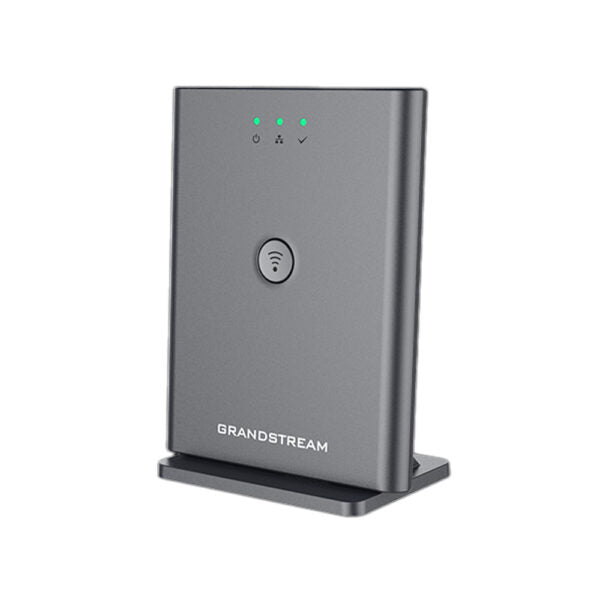
Up to 20 SIP accounts per system; up to 20 lines per handset DECT authentication & encryption technology to protect calls & account 3-way audio conferencing for easy conference calls Supports Push-to-Talk Automated provisioning options include TR-069 and XML config files Use with Grandstream’s UCM series of IP PBXs for Zero Config provisioning HD audio to maximize audio quality and clarity; full duplex speakerphone Supports advanced telephony features, including call transfer, call forward, call-waiting, do not disturb, message waiting indication, multi-language prompts, flexible dial plan and more Weight: 0.82 lbs Dimensions: 5.52 × 2.56 × 4.13 in Phone Type: DECT General Info: Model: DP755 Box Contents: DP755 Base Unit Universal Power Supply Ethernet cable Quick Start Guide GPL statement Air Interface: Telephony standards: DECT Frequency bands: 1880 – 1900 MHz (Europe), 1920 – 1930 MHz (US), 1910 – 1920 MHz (Brazil), 1786 – 1792 MHz (Korea), 1893 – 1906 MHz (Japan), 1880 – 1895 MHz (Taiwan) Number of Channels: 10 (Europe), 5 (US, Brazil or Japan), 3 (Korea), 8 (Taiwan) Outdoor Range: up to 400 meters (DP730) or up to 350 meters (DP722/DP720) Indoor Range: up to 50 meters Peripherals 3 LED indicators: Power, Network, DECT pairing/Paging button One 10/<br>100 Mbps auto-sensing Ethernet port with integrated PoE

About This Product

The Grandstream DP755 is the central component of a scalable DECT system, designed for businesses that need reliable cordless voice coverage across a floor, office, or light industrial space. It is a good fit for environments where running Ethernet to every desk is impractical but high-quality voice mobility is required, such as retail floors, warehouses, or open-plan offices. This base station pairs with Grandstream’s DECT handsets to create a wireless voice network that can support up to 20 SIP accounts, making it suitable for small to medium-sized teams that need to move around while staying connected.

When combined with Grandstream’s UCM series of IP PBXs, the DP755 supports zero-configuration provisioning, which simplifies deployment for a multi-handset system. For businesses using other platforms, it still offers automated provisioning via TR-069 or XML configuration files. This flexibility means it can slot into an existing VoIP setup without requiring a full ecosystem change, though the richest experience is naturally within the Grandstream environment.

A practical consideration is the coverage range. With an indoor range of up to 50 meters from the base station, a single DP755 will cover a modest office. For larger or multi-floor spaces, planning for multiple base stations and handoff between them is essential. The device uses a single 10/100 Mbps Ethernet port with PoE support, so it can be placed for optimal RF coverage without needing a local power outlet, provided your network switch can power it.

For a Canadian business, the DP755 operates in the 1920–1930 MHz DECT band, which is the standard for North America. This avoids the interference issues that can plague Wi-Fi-based cordless phones in dense urban environments like a downtown Toronto office tower. It is a straightforward, carrier-grade base station that prioritizes call security and audio clarity, but it is not a Wi-Fi access point and won’t serve data needs. If your team is already using Grandstream handsets or you’re building a new DECT system from scratch, this is a solid foundation.
Services We Provide
  • Professional Installation & Configuration
  • Ongoing Maintenance & Support
  • Troubleshooting & Repairs
  • System Upgrades & Updates