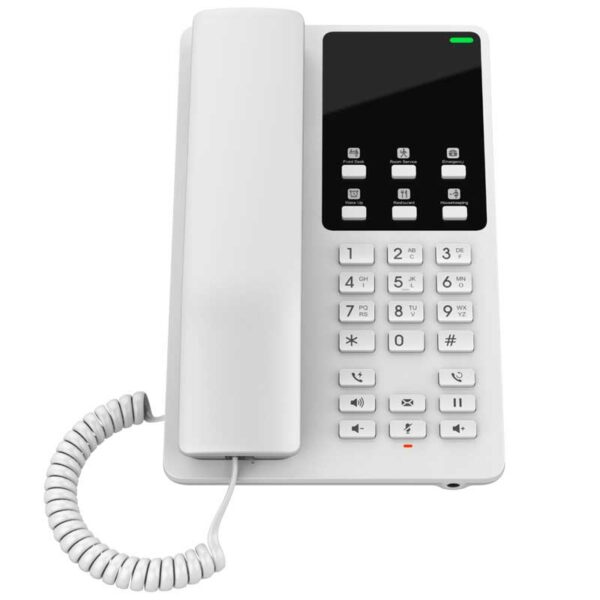
Grandstream GRP2615 10-Line Carrier-Grade IP Phone

Frequently Asked Questions

First check that the phone is receiving a valid IP address from your network, then verify the SIP server address and account credentials are entered exactly as provided by your voice carrier. Confirm that the outbound port (typically 5060) isn't blocked by a firewall on your LAN. If all looks correct, try disabling and re-enabling the SIP account from the phone's accounts menu.
Ensure the Ethernet cable is plugged into the LAN1 port, as only that port supports PoE input. Verify the switch or injector provides 802.3af/at power and that the port isn't administratively disabled. A quick test is to try a known-working PoE device on the same cable to isolate a cabling or switch issue.
This often points to a network address translation or firewall problem. Confirm that the router or SBC is not blocking RTP audio streams (usually UDP ports 5004 to 5059). On the phone's web interface, check the network settings for the correct NAT traversal mode and, if available, set it to 'STUN' or 'Auto' based on your provider's recommendation.
Log into the phone's web interface, go to the Accounts tab, choose an unused account slot, and enter the label, SIP server address, user ID, and authentication password from your provider. Save and apply the change; the line key will appear on the screen when registration succeeds. For mass deployment, you can also push this through GDMS or a provisioning file.
Start by checking the received signal strength on the phone's status display; if it's below -67 dBm, try moving the phone or the access point closer. Interference on the 2.4 GHz band is common, so configuring the phone to prefer 5 GHz (if your network supports it) often stabilizes the connection. Also confirm the encryption type matches what the access point expects.
Yes, the phone supports Bluetooth. Go to Settings > Bluetooth, set it to On, and put your headset into pairing mode. Select the headset from the list of discovered devices and confirm the pairing. Once paired, audio routes to the headset automatically when you answer a call.
Check that the BLF key is configured with the exact extension number and SIP account as it appears on the monitored device. Make sure the monitored phone sends NOTIFY messages for presence; some PBXs require you to enable BLF hinting on the extension. Reprovision the phone after any change and watch for the green/red status indicator to update.
A reboot often clears temporary post-update hiccups—power cycle the phone by disconnecting the Ethernet cable for 10 seconds. If the issue persists, check within GDMS that the correct firmware version was applied and that no other provisioning jobs are running against the device. Should symptoms remain, contact your support provider before attempting any manual rollback.
Power off the phone first. Remove the side cover plate on the GRP2615, align the module's connector with the phone's expansion port, and press them together until they click. Apply power and the module will be detected automatically; then assign keys and functions through the web interface or GDMS.
Verify the power source is delivering enough wattage; if using PoE, test with a power adapter instead to rule out a power delivery problem. Disconnect any accessories like extension modules or USB devices, as a short can prevent startup. If the phone still won't boot, reach out to Grandstream-authorized support, as the secure boot process might need expert diagnosis.
IP Phones

Grandstream GRP2615 10-Line Carrier-Grade IP Phone
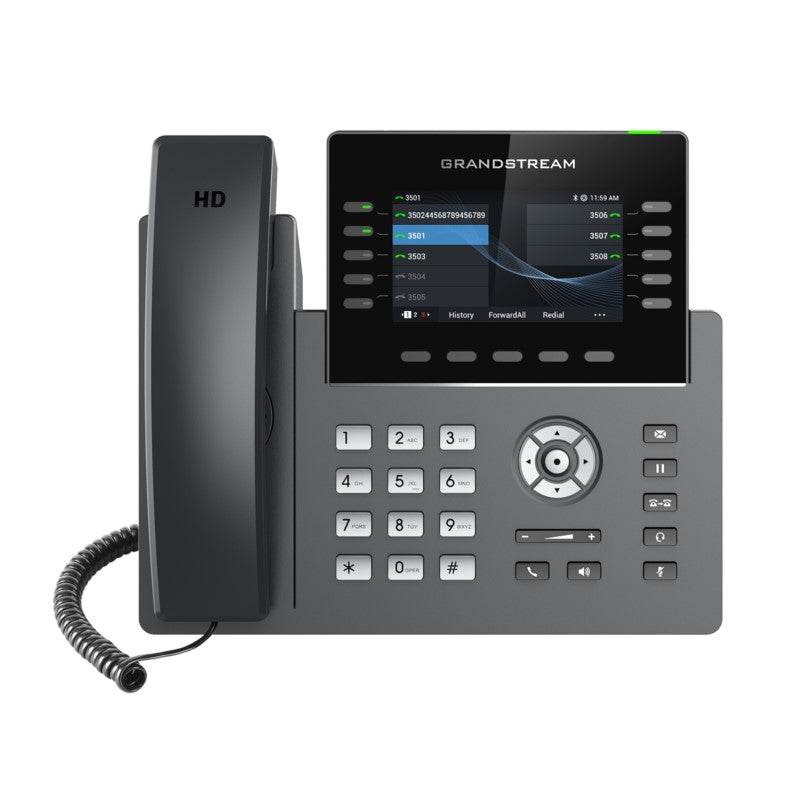
*The GRP2615 is a high-end carrier-grade IP phone designed with zero-touch provisioning for mass deployment and easy management. It supports up to 10 lines and 5 SIP accounts while featuring a sleek design and a suite of next-generation features, including: • Integrated Wi-Fi • Bluetooth support • 40 multi-purpose keys (MPKs) • Available extension module • Dual Gigabit ports with integrated PoE • Swappable faceplates for easy logo customization • High-definition audio and handset/speakerphone capabilities This device is designed to provide enterprise-level security, including: • Secure boot • Dual firmware images • Encrypted data storage The GRP2615 is supported by Grandstream's Device Management System (GDMS), which provides a centralized interface for configuring, provisioning, managing, and monitoring deployments. The phone is built for busy desktop workers and designed for easy deployment by enterprises, service providers, and other high-volume markets. Key Features: • HD audio with handset and speakerphone support • 10 line keys with up to 5 SIP accounts • 40 built-in digital BLF keys; available extension module offers 40 BLF/speed dial keys per module • Enterprise-level protection including secure boot, dual firmware images, and encrypted data storage • Integrated dual-band Wi-Fi 802.11 a/b/g/n/ac (2.4GHz & 5GHz) • Dual switched auto-sensing 10/100/1000 Mbps Gigabit Ethernet ports with integrated PoE • Swappable faceplates for easy logo customization • Integrated Bluetooth Additional Information: • Weight: 2.6 lbs • Dimensions: 14 × 10 × 4 in • Brand: Grandstream

About This Product

The Grandstream GRP2615 is built for demanding desktop environments where a high call volume and many line appearances are the norm. It fits well in reception areas, executive desks, and call center roles that need quick access to multiple lines and busy lamp field (BLF) monitoring. With five SIP accounts and 40 programmable keys, the phone suits a power user who manages several extensions or oversees team presence, while the optional extension module lets the setup grow with a business. In a Canadian context, this model is a common sight in medium to large offices across the GTA that require reliable voice traffic over a gigabit network.

This phone shines in centrally managed deployments where the IT team uses Grandstream's Device Management System (GDMS) for zero-touch provisioning and firmware control. It pairs naturally with Grandstream UCM series IP PBXs and SIP trunking services, making it a reasonable choice for service providers delivering hosted voice to clients. The dual Gigabit ports with PoE keep cabling simple, and the swappable faceplates offer a tidy way to present custom branding without stickers or after-market modifications.

A buyer should note the GRP2615 is overkill for a small office where a single line and a handful of calls per day are sufficient; a simpler Grandstream model would reduce cost without sacrificing call quality. The integrated Wi-Fi and Bluetooth add flexibility, but if the phone will always live at a wired desk, those radios go unused. The phone is relatively large and heavy at 2.6 lbs, so wall-mounting or sharing a cramped countertop should be planned in advance.

For businesses evaluating whether this is enough phone, the GRP2615 lands in a sweet spot: it is not the top-of-line executive video phone, but it delivers carrier-grade voice and security features for the daily workflow. It will feel underpowered only in roles that require video calling or advanced unified communications integrations that the phone does not attempt to provide.
Services We Provide
  • Professional Installation & Configuration
  • Ongoing Maintenance & Support
  • Troubleshooting & Repairs
  • System Upgrades & Updates