Yealink Room Cable Hub RCH40 E2 1303166

Frequently Asked Questions

Verify that the power adapter is fully seated at both the wall outlet and the switch’s DC jack, and that the outlet is supplying power (try a known-working device). If you are using a third‑party adapter, make sure it matches the required 48 V, 2 A output. A power cycle—unplugging for 10 seconds and then reconnecting—can also reset the internal lockout. If the LED stays off, the unit likely needs a replacement.
First confirm that the Dante device is receiving PoE by checking its own power indicator. Next, try a different known-good Ethernet cable and a different port on the RCH40. If the device still doesn’t show up in Dante Controller, temporarily connect it to another PoE switch to rule out a fault on the endpoint. If the issue persists, a Toronto-based VoIP support provider can usually resolve this remotely.
A flashing red PoE budget LED means the total power draw from connected devices has exceeded the 90 W limit or one port is trying to draw more than 30 W. Disconnect one or more powered devices, then reconnect them one at a time, observing the LED after each step. Distributing higher-draw devices across fewer ports can also help if multiple ports are lightly loaded but the sum still exceeds the budget.
Check the label on the bottom of the switch—it must read ‘RCH40 E2.’ The original RCH40 has EEE enabled by default, which is known to disrupt connectivity with the CM20, CS10, and some Dante devices; the E2 edition disables EEE specifically to prevent this. If you already have an E2 unit, inspect the Ethernet cable and ensure the microphone’s firmware is current, as a faulty cable or outdated firmware can mimic dropouts.
Swap the Ethernet cable with a known-working patch cord—a damaged pair can carry DC power but fail to link for data. Plug the same device into a different RCH40 port and check whether you get link lights and an IP address. If the port still shows no data link while another port works, that port may have a hardware fault and the switch should be replaced.
Make sure the RCH40 is placed in a well-ventilated area, not stacked under other equipment or inside a sealed podium. The operating humidity range is 5%–90%, but high ambient temperatures above the switch’s rating can trigger over‑current protection. Unplug the adapter, let the unit cool for 15 minutes, and try again; if the problem recurs in a cool environment, the power supply may be failing.
Look at the model number printed on the label on the underside of the switch—it will explicitly say ‘RCH40 E2.’ The packaging and the quick start guide also list the E2 designation. If your unit only shows ‘RCH40’ without the E2 suffix, it is the original edition and might cause compatibility issues with those devices.
Yes, the RCH40 E2 supports standard 802.3af and 802.3at PoE, so any compliant device will receive power and data. Just ensure the device’s power requirements stay within 30 W per port, and that the total load across all four ports does not exceed 90 W.
It is completely unmanaged—there is no web interface or CLI. Simply connect the power adapter and plug in your devices; the switch will automatically negotiate speed, duplex, and PoE, with basic QoS applied to prioritize voice traffic without any user setup.
Yes, you can connect the uplink port of another switch to any port on the RCH40 to expand port count. Keep in mind that the RCH40 does not provide PoE on that link to power the downstream switch, so the second switch will need its own power supply.
Accessories

Yealink Room Cable Hub RCH40 E2 1303166
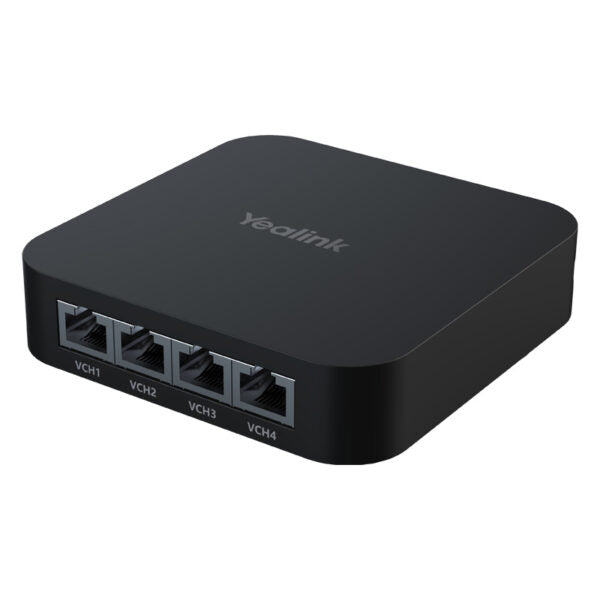
Meet Yealink RCH40 E2, a Gigabit PoE+ Switch designed for seamless audio and video networking in meeting rooms. Key features include: • Up to 90w PoE Budget • 4x 10/100/1000Mbps Port • 802.3af/at-compliant • PoE Priority Control • Compatible with CM20 & CS10 or Dante devices • Qos Supported • EEE Disabled Note: There are two editions of RCH40, and Yealink CM20 & CS10 or Dante devices require the EEE disabled version (RCH40 E2) for compatibility. Additional Information: • Weight: 1.83 lbs • Dimensions: 3.94 × 4.33 × 0.91 in • Brand: Yealink • Industrial Connectivity: PoE • PoE Support: Yes • PoE Budget: Low (30-70 W) Technical Specifications: GENERAL INFO: • Model: RCH40 E2 • Features: + 4x 10/100/1000Mbps Port + 802.3af-compliant + Multiple deploy method + 90w total PoE Budget (30w per port) • Package includes: + RCH40 Switch + 48V 2A Power Supplier + Quick Start Guide Physical Feature: • 1x LED indicate Power state • 1x LED indicate PoE Budget • Support standard PoE Supply (802.3af) • Power adapter: PSE 48V 2A • Dimension (WDH): 100mm x 100mm x 23mm • Operating Humidity: 5%-90% For a full list of specifications, please refer to the product datasheet.

About This Product

The Yealink RCH40 E2 is a compact, purpose-built PoE+ switch tailored for meeting room installations that rely on Yealink’s audio endpoints—particularly the CM20 ceiling microphone and CS10 sound bar—or any Dante-enabled audio device. It strips away complexity to deliver just four powered gigabit ports with a total 90 W budget, enough to run a couple of microphones and a speaker without burdening the room with a larger managed switch. This E2 edition exists solely to resolve a compatibility quirk: Energy Efficient Ethernet (EEE) is disabled out of the box, which is mandatory for stable operation with the CM20, CS10, and certain Dante hardware.

For a small huddle space or a focused Microsoft Teams Room, this switch often pairs cleanly with a Yealink meeting bar or a dedicated mini-PC, handling PoE duties for the audio peripherals while leaving the main network drop for data. It can also serve as a simple PoE injector replacement when you only need to power a single Dante device, though prioritizing port count over cost may make a basic injector more economical. The unmanaged nature means there is no VLAN tagging or per-port rate limiting—the on-board QoS is automatic and sufficient for voice traffic, but it won’t replace a managed switch in environments that demand traffic segregation.

The practical ceiling becomes apparent when room designs grow. If you plan to deploy multiple high-power PTZ cameras, a DSP, and a handful of Dante mics, the 90 W budget and four ports will run out quickly; in those cases, a higher-capacity managed PoE switch is a better long-term investment. Conversely, if a room’s only powered device is a single conferencing bar that already receives PoE from a display or a USB-C hub, the RCH40 is overkill. For Canadian businesses outfitting huddle rooms in Toronto or Vancouver, the switch provides a clean, purpose-fit solution that avoids the complexity of a full managed switch, but integrators should keep a spare power adapter on hand—the external 48 V 2 A brick is essential and not interchangeable with lower-rated supplies.
Services We Provide
  • Professional Installation & Configuration
  • Ongoing Maintenance & Support
  • Troubleshooting & Repairs
  • System Upgrades & Updates