Fanvil Y501W-Y Healthcare Intercom
Frequently Asked Questions
Start by confirming that the device has network connectivity: check the status page on the web interface to see if it is obtaining an IP address. Verify the SIP server address, username, and password under the account settings—sometimes a typo or extra space slips in. If registration still fails, try temporarily disabling any firewall or SIP ALG on your router to rule out packet interference.
First, look at the Wi-Fi signal strength from the intercom's position. In a hospital, walls and metal equipment weaken signals dramatically; try moving the access point closer, or consider switching to a 5 GHz network if 2.4 GHz is congested. Reboot the intercom and access point, and ensure the SSID is not hidden—some devices struggle with hidden networks during reconnection.
Make sure the microphone and speaker are not obstructed by a cover or mounting bracket that blocks the grille. Access the device's web interface and check the audio settings to confirm the volume level isn't set too low in the profile. If you're using a headset or handset, unplug them to test the built-in speaker alone.
Log into the intercom's web interface and navigate to the Function Key or DST settings. The pendant uses 433 MHz and needs to be paired by putting the intercom into learning mode and then pressing the pendant button. Refer to the pairing section of the manual; if it doesn't pair, replace the pendant battery and ensure you're within 10-15 metres without large metal obstructions.
This can happen after a brief power flicker or surge. Disconnect the power source (unplug the PoE cable or power supply), wait 30 seconds, then reconnect. If it still hangs, try a different PoE switch port or power supply—insufficient power delivery can cause incomplete boot. Avoid factory resetting until you've confirmed consistent power.
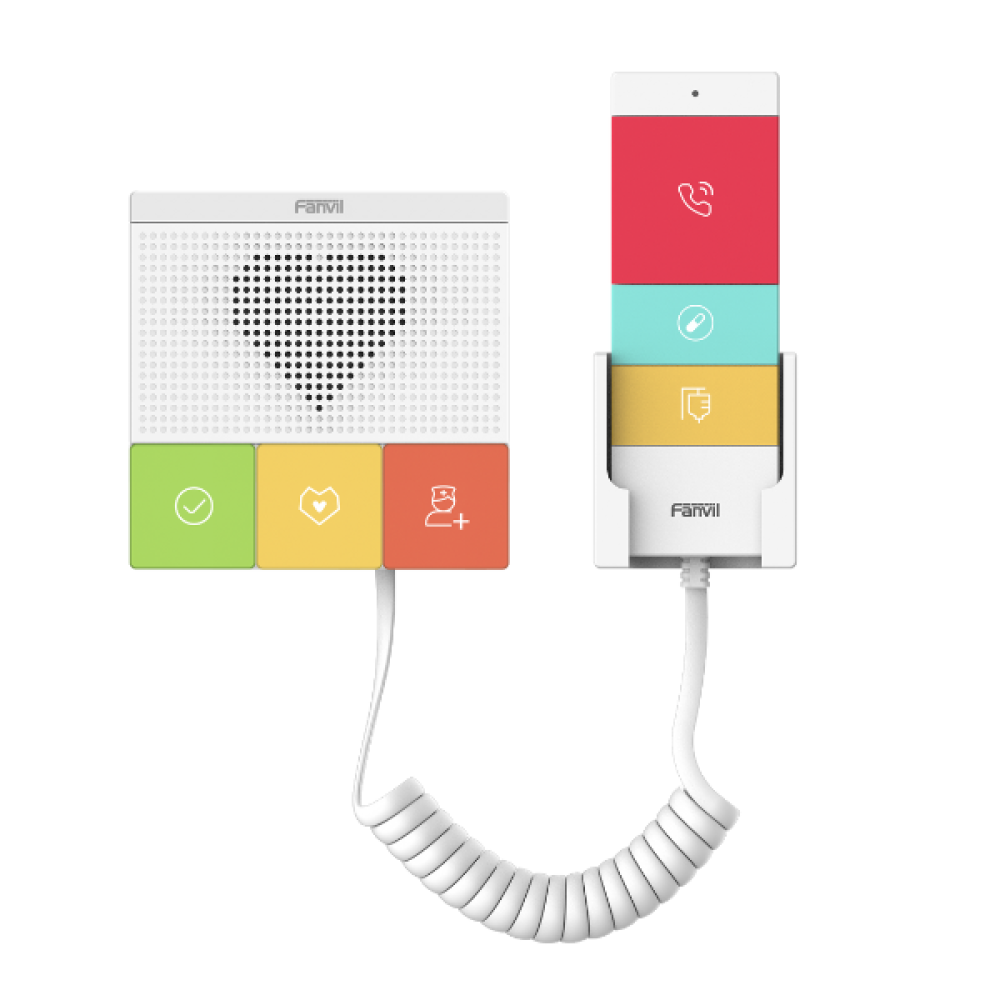
Yes, each of the detachable DSS keys can be configured through the web interface or auto-provisioning file. You can assign them to speed dial a nurse station, send a multicast page, or trigger a code blue announcement. The physical labels are paper inserts, so you can swap them to match the new functions.
If you have Ethernet cabling at the install location, PoE provides the most stable connection and power, eliminating Wi-Fi interference worries. Use Wi-Fi where running cables is too expensive or disruptive, but recognize you'll need to manage signal reliability and possibly add an access point nearby. For critical life-safety messaging, wired is always the safer path.
This usually means the provisioning server URL is unreachable or incorrect. Check that the device's networking is functional and that it can reach the provisioning server—ping it from another device on the same subnet. If using DHCP option 66, confirm the DHCP server is sending the correct tftp or http address. Re-enter the correct URL manually in the settings to get past the error.
IP Paging
Fanvil Y501W-Y Healthcare Intercom
• The Fanvil Y501W-Y Healthcare Intercom is designed to provide a seamless and reliable communication solution for healthcare facilities, featuring a durable and hygienic design that meets the needs of hospitals, clinics, and nursing homes. Key Features: • Customizable settings with six detachable DSS keys • Built-in 2.4G & 5G Wi-Fi connectivity • HD Audio with G.722, Opus, Full-duplex Acoustic Echo Canceller (AEC), and Noise Reduction technologies • Support for a handset and wireless pendant key via 433MHz remote control • Power Supply Mode: PSU / PoE • Installation options: wall-mounted or embedded in an 86-box For a full list of specifications, please refer to the product datasheet.
About This Product
The Fanvil Y501W-Y fills a specific niche in healthcare environments where hygiene, reliability, and clear communication are non-negotiable. It is built for patient rooms, nurse stations, and treatment areas in hospitals, long-term care homes, and clinics. Unlike a generic office phone or paging speaker, this intercom is designed to be wiped down frequently and installed flush against the wall, reducing dust traps. It replaces standalone call buttons or ageing analog intercoms that can't handle modern VoIP workflows, and it pairs naturally with SIP-based nurse call servers or hosted PBX platforms already common in Canadian healthcare settings.
What makes this device worth considering is its dual-mode wireless capability: Wi-Fi means you can place it where Ethernet cable runs are impractical, and the 433 MHz pendant key support adds a personal safety element for patients or residents. That said, anyone evaluating it should be clear-eyed about the limitations of Wi-Fi in medical buildings. Thick walls, lead-lined radiology suites, and crowded 2.4 GHz spectrum from patient monitors and guest devices can create connectivity challenges that a wired PoE connection sidesteps. If stability is paramount, using the PoE option is almost always the better choice.
It is not a full nurse-call system in a box. The Y501W-Y is an endpoint—it handles the audio and one-way button press—but it relies on an external platform to light up hallway dome lights, log events, or escalate to a smartphone. For a small clinic or a single wing with limited budget, it's a practical, focused tool that avoids ripping out walls for wiring. For a large hospital that needs centralized reporting and integration with bed exit alarms, it would be just one component among many, and you would need to verify SIP compatibility with the facility's existing middleware.
For Toronto-area deployments or anywhere in the GTA, this intercom's ability to register to a cloud VoIP provider means a clinic can avoid an on-premise PBX altogether. Be sure to check that your provider supports the device template for Fanvil, and always pre-provision the Wi-Fi credentials before mounting it in a patient area where physical access is restricted later.
What makes this device worth considering is its dual-mode wireless capability: Wi-Fi means you can place it where Ethernet cable runs are impractical, and the 433 MHz pendant key support adds a personal safety element for patients or residents. That said, anyone evaluating it should be clear-eyed about the limitations of Wi-Fi in medical buildings. Thick walls, lead-lined radiology suites, and crowded 2.4 GHz spectrum from patient monitors and guest devices can create connectivity challenges that a wired PoE connection sidesteps. If stability is paramount, using the PoE option is almost always the better choice.
It is not a full nurse-call system in a box. The Y501W-Y is an endpoint—it handles the audio and one-way button press—but it relies on an external platform to light up hallway dome lights, log events, or escalate to a smartphone. For a small clinic or a single wing with limited budget, it's a practical, focused tool that avoids ripping out walls for wiring. For a large hospital that needs centralized reporting and integration with bed exit alarms, it would be just one component among many, and you would need to verify SIP compatibility with the facility's existing middleware.
For Toronto-area deployments or anywhere in the GTA, this intercom's ability to register to a cloud VoIP provider means a clinic can avoid an on-premise PBX altogether. Be sure to check that your provider supports the device template for Fanvil, and always pre-provision the Wi-Fi credentials before mounting it in a patient area where physical access is restricted later.
Services We Provide
- Professional Installation & Configuration
- Ongoing Maintenance & Support
- Troubleshooting & Repairs
- System Upgrades & Updates